A Nation Divided
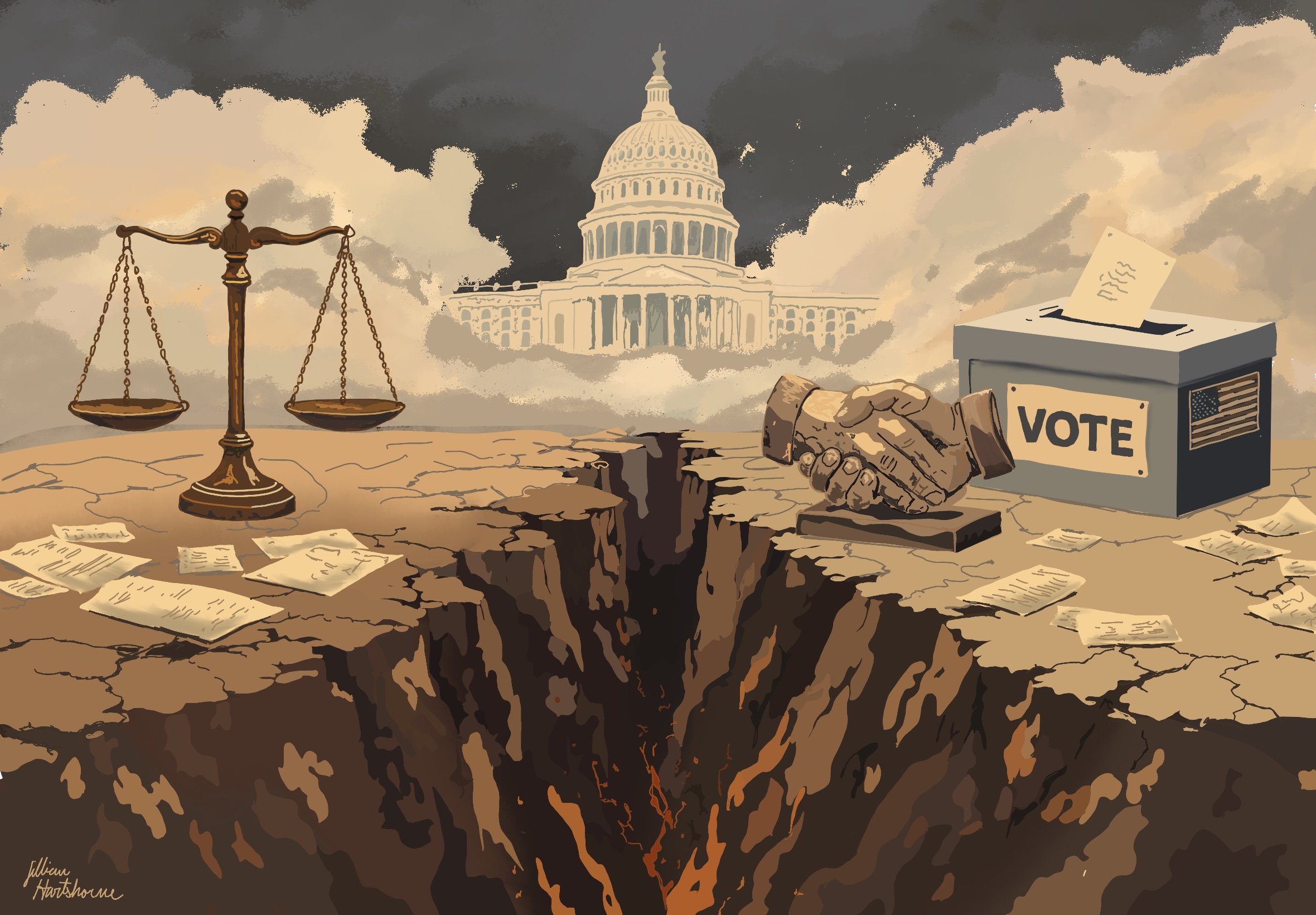
Article by: Presley Frank / Graphic by: Jillian Hartshorne
Five months after Charlie Kirk’s assassination at Utah Valley University, the question worth asking is not what happened, but what didn’t. The nation did not reflect; it did not reckon. The fracture exposed by his killing, and by the politically targeted murders of Democratic lawmaker Melissa Hortman and her husband just months before, has only deepened. Both tragedies revealed a society desensitized to violence, quick to categorize lives by political alignment, and slow to confront the human cost of division. What has followed has confirmed it.
However, Charlie Kirk’s assassination did not create the fractures in our society. America has been broken for a long time. Violence is constant: children are dying in school shootings, families are torn apart by immigration policy, innocent civilians are bombed abroad in wars we collectively ignore, and communities are continually targeted because of race, identity, or religion. Yet, these tragedies rarely spark national outrage in the same way. The selective shock reveals the biases embedded in our culture. Partisanship and racial and ideological hierarchies determine which lives are spotlighted and which are ignored, and this is not new. The violence, the suffering, and the injustice have always been here. What Kirk’s death exposes is the weaknesses of a nation that pretends empathy is universal, when in reality, it is conditional, unevenly applied, and deeply entangled with power, privilege, and politics.
These acts of violence are not anomalies. They are symptoms of a national crisis in which hatred has been normalized, and empathy has been erased. When the line between rhetoric and bloodshed dissolves, tragedy becomes a tool to reinforce partisan loyalty rather than a chance to pause and reckon with what led us here. Republican leaders, including President Donald Trump, immediately framed Kirk’s assassination as proof of Democratic extremism, blaming one side for the violence and deepening the national divide. Democrats condemned the killings without partisan blame, yet their calls for empathy were often drowned out by political opportunism. Rather than uniting in shared horror at political violence itself, the nation fractured further, proving that outrage is now more powerful than compassion.
The empathy gap extends beyond politicians to the public itself. Footage of Kirk’s assassination circulated endlessly on social media, where some reacted with horror, while others mocked or cheered. Meanwhile, the deaths of Democratic lawmakers barely registered outside official statements. We have reached a moment where human suffering is consumed as content, filtered through algorithms and memes, and evaluated by political alignment rather than intrinsic worth. Tragedy ceases to be tragedy; it becomes entertainment, a weapon, or a punchline. And while no one is obligated to mourn every public figure, celebrating death eliminates our collective capacity for empathy. Without a shared acknowledgment of tragedy, the nation cannot cultivate empathy, and without empathy, the political divide becomes insurmountable.
This crisis is amplified by generational stress and mental health struggles. Young people are navigating digital spaces that politicize despair, amplify extremism, and reward nihilistic engagement. The perpetrators of recent attacks, like the alleged 22-year-old responsible for Kirk’s assassination (who told his roommate he “had enough of the hatred”) are emblematic of a generation grappling with isolation, anxiety, and a relentless flood of online ideology. Mental health in America is officially a public health emergency, but policy lags behind the scale of the problem. Violence is not only political; it is symptomatic of societal neglect.
America could have used these tragedies as a moment to confront the dangers of polarization, to insist that hatred is unacceptable. Instead, they became fuel for the very culture of division that produced them. Leaders who weaponize grief, media that thrive on outrage, digital spaces that radicalize the vulnerable, and a citizenry desensitized to suffering are all complicit. Addressing this requires investment in mental health, regulation of extremist online environments, and a cultural shift toward empathy that prioritizes human dignity over political advantage.
Political violence is a mirror. It reflects the loss of moral discipline, the collapse of empathy, and the consequences of treating ideology as permission for cruelty. The nation must confront what it has allowed to grow unrestrained. The divide is real, and it’s deadly. If we ignore these realities, we risk losing more than democracy; we risk losing our humanity.
Bibliography:
Beshay. 2025. “Americans Say Politically Motivated Violence Is Increasing, and They See Many Reasons Why.” Pew Research Center. October 23, 2025. https://www.pewresearch.org/short-reads/2025/10/23/americans-say-politically-motivated-violence-is-increasing-and-they-see-many-reasons-why/.
HPIS Staff. 2025. “Speaker Emerita Melissa Hortman, Husband Killed in Attack - Session Daily - Minnesota House of Representatives.” Mn.gov. 2025. https://www.house.mn.gov/sessiondaily/Story/18843.
News, PBS. 2025a. “How Recent Political Violence in the U.S. Fits into ‘a Long, Dark History.’” PBS News. September 12, 2025. https://www.pbs.org/newshour/politics/how-recent-political-violence-in-the-u-s-fits-into-a-long-dark-history.
———. 2025b. “Analysis: Why Charlie Kirk’s Killing Could Embolden More Political Violence.” PBS News. September 14, 2025. https://www.pbs.org/newshour/politics/analysis-why-charlie-kirks-killing-could-embolden-more-political-violence.