The Lost Art of Vulnerability
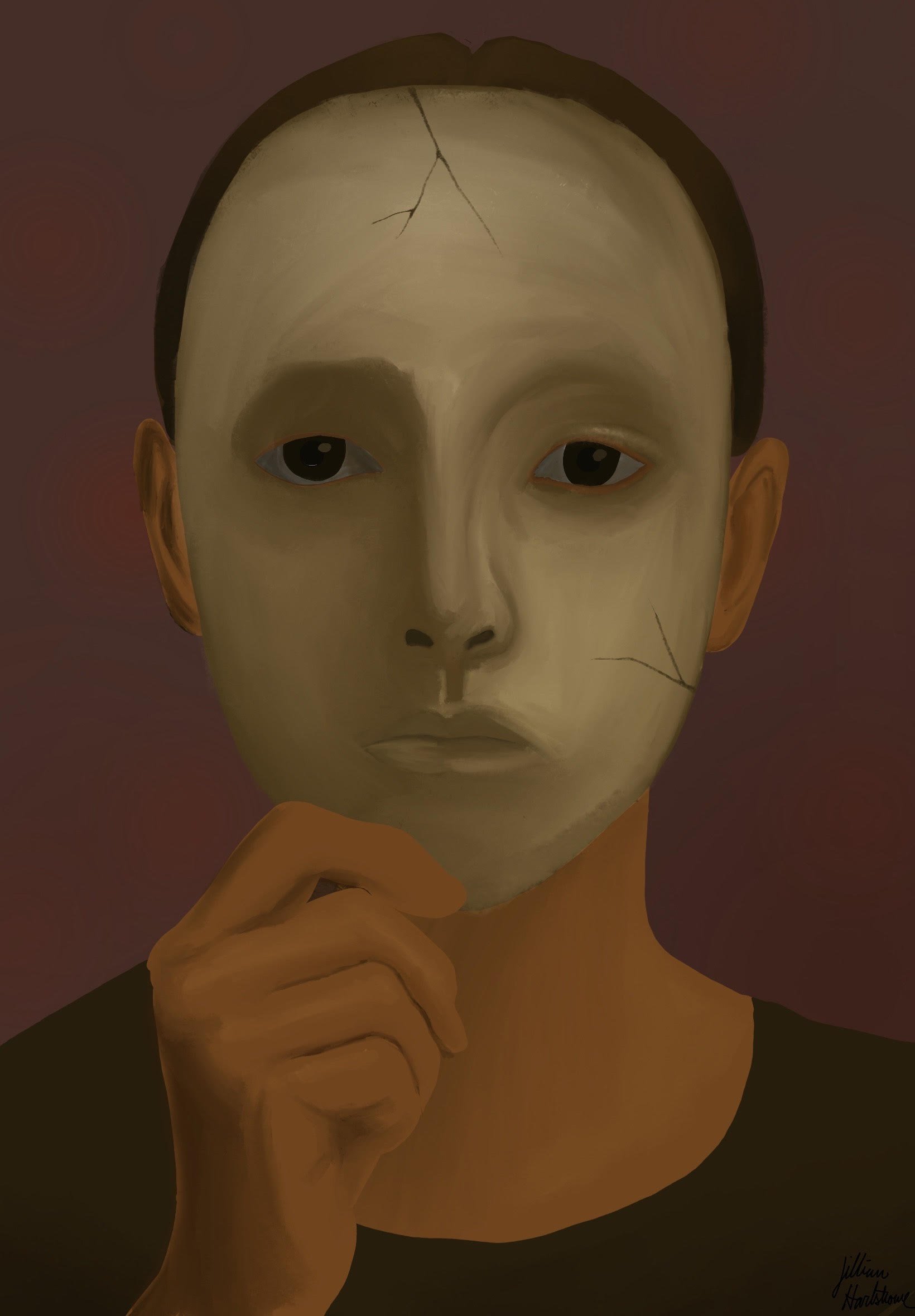
Article by: Liana Tang / Graphic by: Jillian Hartshorne
Watching Jacob Elordi edits was not the way I expected to formulate my next Group Chat for Change piece. Yet, one particular clip sparked an idea. An interviewer asks, “What is one lost art you wish would come back in style?” While his answer is shame, I began to wonder what mine would be. A lost art. Some may say the art of chivalry or filial piety should return. However, those customs are brought on by values instilled by culture and religion. Yet, there is a universal necessity, an art, that is buried under centuries of stigma and norms - Vulnerability.
Despite a nationwide progressive movement towards authenticity, a more stubborn culture persists. This culture rewards composure, confidence, and self reliance both emotional and physical. While corporate CEOs and instagram models may preach being one's true self, in practice our society still evokes the need to hide fears and wear masks because asking for help instills a sense of weakness and risk, especially in teenagers. According to the American Psychological Association, 93% of parents believe that their children have sufficient mental health resources and stability. This number offers a stark contrast to the reality- only 40% of teenagers feel supported. The numbers cannot be ignored. The remaining 50% of teenagers are not vulnerable enough to ask for sufficient resources or help from the supposed “trusted adults” that are placed on posters in school bathrooms. The remaining half of teenagers are forced to retreat their needs to the corners of their mind, building up until it is materialized as depression, anxiety, or what the CDC classifies as “low life satisfaction.”
The reason as to why we continue to suppress our needs becomes clearer when viewing Maslow’s Hierarchy of Needs. Assuming one's physiological needs are met, one must feel a sense of personal security before assuming love and belonging. In terms of vulnerability, one must feel a sense of safety in their surroundings before choosing to be emotionally intimate. The barrier between these two levels is a cultural stigma against vulnerability. One cannot feel emotional safety if their very upbringing does not allow conversation about it. Gallup, a global research organization highlights this very gap through a survey which revealed that only 55% of parents have honest conversations with their children regarding mental health. The leftover 45% of teens are left to explore mental health without parental support, often leaving this exploration forgotten and buried.
While the numbers and statistics offer a seemingly bleak outlook on the future of vulnerability, humans, especially teenagers, find support in unlikely places. Vulnerability is an art, and as the artist, teens may choose who they share it with. With this analogy in mind, one’s art may be meaningful to only a select population. The art of vulnerability is not lost yet, as teenagers find themselves incredibly vulnerable with close friends and even siblings. It is common knowledge that teenagers tend to spend more time with friends rather than family, which is often accredited to one’s desire for personal autonomy or a transition into college. However, the reality is that teenagers often feel safer with their friends, who promote feelings of acceptance and offer themselves as support systems. Furthermore, healthy teenage friendships often have underlying themes of shared experiences with mental health, especially if there is a commonality in parental resistance towards the topic. Teenagers in particular offer each other personal security, which unlocks the next level of love and belonging, which further allows teens to explore topics of self-esteem and growth. Thus, support is present in unlikely places, planting roots of comfort and understanding that will hopefully spread into future generations.
On the other hand, some may still believe that vulnerability is a weakness, rather than a movement of resilience. The dictionary even defines vulnerability as being in a "state of weakness.” Yet, vulnerability is anything but. While social stigmas and norms have painted it as a topic to be feared and avoided, vulnerability is helpful, and some may even say life-changing. An article by University of Southern California researcher Hannah L Schacter reveals that days where adolescents felt supported by family and friends, they reported higher levels of happiness and sociability. Furthermore, vulnerability allows for more authentic relationships. When real needs and anxieties are shared with others, relationships deepen past surface-level similarities. Through honesty, true relationships become reality, creating support systems for oneself and others that further promote vulnerability and openness.
Not only does vulnerability have a positive effect on one's interpersonal relationships, it also has a positive effect on one's intrapersonal relationship with themselves. According to Psychology Today, vulnerability allows one to develop greater resilience. It is revealed that when one faces challenges with support, overcoming obstacles becomes easier. Without this support system, problems tend to be avoided and build up on each other, fostering mental health problems. However, a support system will help instill a sense of self-confidence, which allows one to face future obstacles with strength and proactiveness.
Relearning vulnerability is not a social media fad or a loud, cultural movement. To be vulnerable is to not just survive, but to live. It is a marker of safety and control. More so than safety and control, vulnerability is a mark of confidence. It is the confidence that others will continue to see yourself as strong despite your weaknesses, courageous despite your fear, and resilient despite your fragility. While it is easier said than done, small steps towards honesty with yourself and those around you will open a world of confidence and truth.
Works Cited
American Psychological Association. “Teen Social-Emotional Support: Only 58.5% of U.S. Teens Report They ‘Always or Usually’ Get the Support They Need.” Monitor on Psychology, April-May 2025, www.apa.org/monitor/2025/04-05/teen-social-emotional-support. Accessed 16 Nov. 2025.
Smith, Kendra. “Maslow’s Hierarchy of Needs.” ThoughtCo., 26 Jan. 2024, www.thoughtco.com/maslows-hierarchy-of-needs-4582571. Accessed 16 Nov. 2025.
Jones, Jeffrey M. “Parents Avoid Hard but Helpful Conversations with Gen Z Kids.” Gallup News, 20 Sept. 2023, news.gallup.com/poll/645602/parents-avoid-hard-helpful-conversations-gen.aspx. Accessed 16 Nov. 2025.
Ankumawat, Dr. Amank. “Why Teens Are More Comfortable with Friends Than Parents.” Medium, 3 June 2022, medium.com/@dramankumawat2007/why-teens-are-more-comfortable-with-friends-than-parents-e3823885fdcc. Accessed 16 Nov. 2025.
Wood, Jessica. “3 Benefits of Vulnerability.” Psychology Today, 31 Oct. 2022, www.psychologytoday.com/us/blog/click-here-for-happiness/202210/3-benefits-of-vulnerability. Accessed 16 Nov. 2025.
“Vulnerable.” Merriam-Webster.com Dictionary, Merriam-Webster, www.merriam-webster.com/dictionary/vulnerable. Accessed 16 Nov. 2025.