The Radicalization of Religion
Article by: Michelle Yap / Graphic by: Kailyn Mai
“Congress shall make no law respecting an establishment of religion, or prohibiting the free exercise thereof.” - The First Amendment
When asked about their morals, individuals often cite their religious beliefs. For many people, faith provides structure, meaning, and a sense of accountability beyond themselves. Religion can inspire humility, compassion, charity, and self-restraint, fostering humanity and empathy among people. However, the problem arises when religion ceases to function as an individual source of conscience and becomes more of a public instrument of control. The First Amendment addresses that danger, protecting the free exercise of religion while rejecting the imposition of one set of religious beliefs on everyone else.
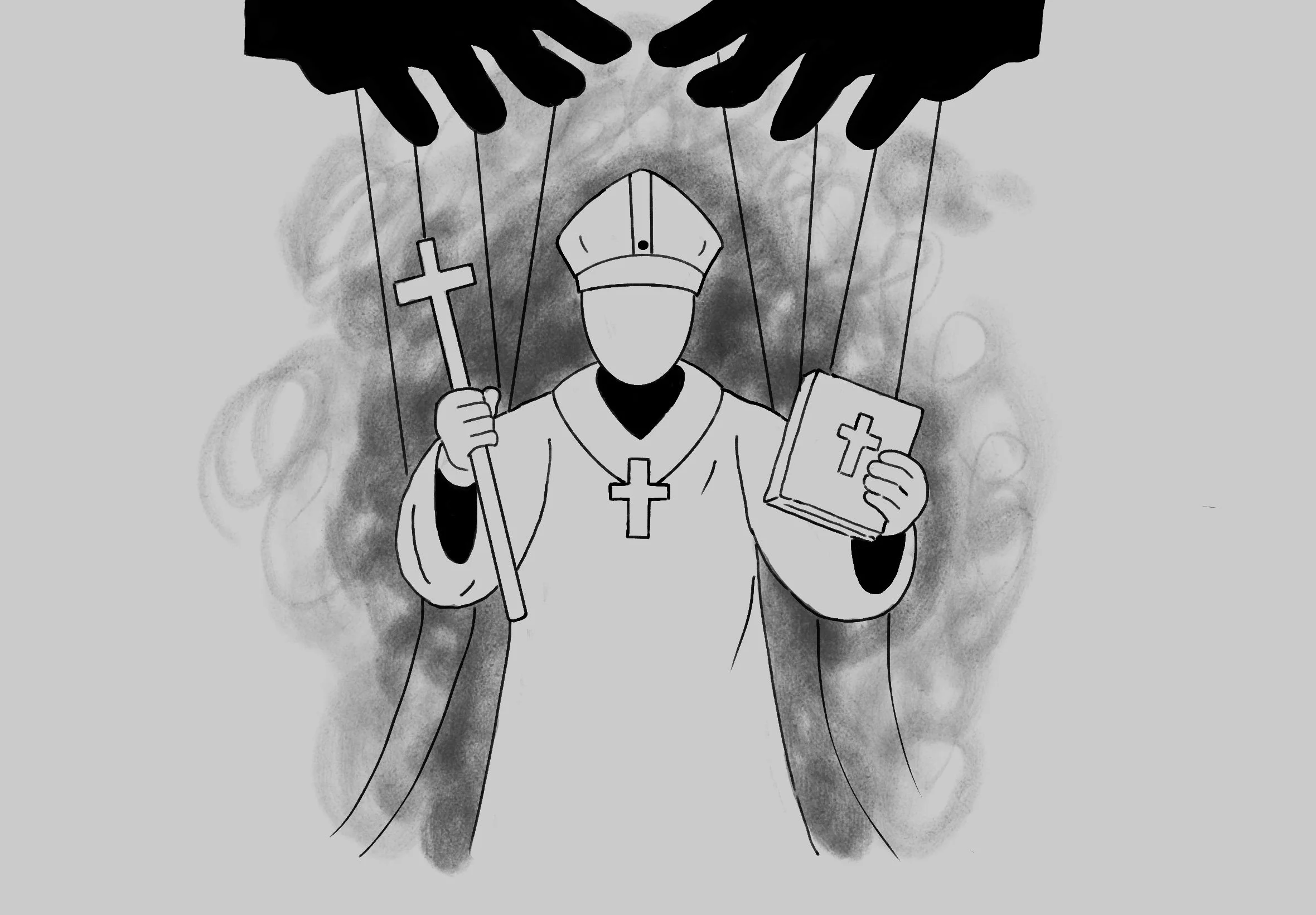
That distinction matters because religion itself is not the threat; rather, the threat is what happens when faith is radicalized and infused with fear, political identity, and the desire to dominate others in the name of a “higher power”. Once that occurs, religion is no longer simply about spirituality; it becomes a weapon used to justify hierarchy and sanctify prejudice. The language becomes moral, allowing enforcers to justify their actions, but motives shift from personal devotion to tainted efforts for “righteousness”.
This is why the radicalization of religion is so dangerous. It gives individuals the ability to take advantage of a group of people following a specific moral code to commit acts they wouldn’t have otherwise, in the name of that moral code. It allows people and governments the ability to claim divine authority for policies that are, objectively speaking, about regulating bodies, silencing identities, and preserving social dominance. Once religion is extrapolated from a private moral compass and into political and social mandates, disagreement is no longer seen as natural differences; it becomes demonized as sin.
One of the most prevalent examples of this appears in debates over abortion and reproductive rights. People absolutely have the right to oppose abortion on religious grounds. In a free society, moral disagreement is inevitable. However, there is a massive difference between living according to your personal beliefs and using the force of law to make those beliefs compulsory for everyone else. Even within the Christian population in the US, data shows that there isn’t a unanimous stance on this issue. According to Pew’s March 2026 polls, around 74% of White evangelical Protestants say that abortion should be illegal in all or most cases, while 63% of White non-evangelical Protestants, 68% of Black Protestants, and 57% of Catholics believe that abortion should be legal in all or most cases.
In a country that so often praises freedom of religion and freedom of expression, it is hypocritical to let one religious doctrine determine medical laws for everyone else. Church teachings and personal beliefs may hold that life begins at conception, but science describes a more gradual biological process: fertilization creates a single-celled zygote, and by around day five, the developing embryo is typically still a blastocyst, composed of roughly 50 to 150 cells, preparing for implantation. From there, the embryonic stage continues through the first 8 weeks as organs and bodily systems begin to form. The American College of Obstetricians and Gynecologists also notes that viability is not a fixed point at conception and that the capacity to experience pain is not established until at least 24 to 25 weeks.
Additionally, a common argument is that abortion should be banned because killing is illegal, ignoring the fact that society criminalizes acts like murder because allowing them would destroy the basic security that social order depends on, just as decriminalizing theft would destabilize the economy. Abortion, however, does not function that way in society, and its legalization does not lead to social collapse. Because of that, the same broad moral and legal arguments used for murder cannot simply be transferred or simplified when discussing abortion, especially given the enormous range of circumstances women seeking abortions may be in. Even the law recognizes that killing itself is not black-and-white: there are still degrees, contexts, and legal distinctions depending on intent and circumstances. Reducing abortion to a single absolute category ignores that nuance. If anything, abortion is more morally and situationally complex, as seen in the sheer amount of debate and controversy regarding the topic, which is why simplistic criminalization does not work.
Entire societies should not be obligated to follow a specific subjective set of beliefs merely because the people in power hold those personal beliefs. Anti-abortion politics is not simply about “what religion says.” It reflects the political use of particular religious interpretations while ignoring the existence of millions of both religious and non-religious people who do not agree. When one interpretation claims exclusive moral authority over the law, the issue is no longer merely a matter of faith.
The same pattern appears in hostility towards homosexuality. Too often, religious-based rhetoric and stigma is not just used to express disapproval, but also to legitimize exclusion, shame, and punishment. Around the world, anti-LGBTQ discrimination is still regularly defended with moral or religious language. In Uganda, for example, the constitutional court upheld most of the country’s anti-homosexuality law in 2024. Reuters reported that the law includes life-imprisonment for consensual same-sex relationships and the death penalty for what it defines as “aggravated homosexuality”. This is not just happening in Uganda. All over the world, the persecution and even killing of people is justified by citing moral causes, which is ironic in its own sense.
The suppression of women in some countries offers another example of how religion can be radicalized into a system of domination. In Afghanistan, Reuters reported in 2024 that the Taliban formally codified morality rules requiring women to cover their faces, while also imposing a broader set of restrictions on public behavior. Another Reuters report in 2025 summarized how the Taliban had rolled back women’s rights since taking power, including restrictions on education, work, and public life and interactions. Authorities have required women to cover their faces, restricted their movements without a male guardian, and barred them from places such as parks, gyms, universities, and secondary schools, all based on a specific interpretation of Islamic law. That justification is deeply contested by both Muslim scholars and even some Taliban officials themselves. For example, in 2025, the Taliban’s acting deputy foreign minister said that restrictions on girls’ and women’s education were not in line with Sharia law and argued that during the time of the Prophet Muhammad, “the doors of knowledge were open to both men and women.” A Georgetown Institute for Women, Peace and Security brief likewise states that neither the Quran nor the hadith can reasonably be used to justify denying women an education, and the Yaqeen Institute argues that Islam is meant to affirm women’s dignity, property rights, and equal humanity before God. That contradiction matters because it shows that these policies are not actually what Islam is rooted in, but selective, patriarchal, and political interpretations of religion used to make female subordination appear sacred.
In each of those cases, religion is invoked as the justification, but they all lead to the same conclusion: fewer choices, less autonomy, and more power concentrated in the hands of those defining “morality” for everyone else. This is the danger of radicalization. It isn’t just intense belief—it’s the transformation of that belief into a mechanism of enforcement.
The broader political version of this issue is religious nationalism. This is where religion is no longer about faith, but about identity, belonging, and who is seen and recognized as a “real” member of the nation. Christian nationalism is the belief that the US is, and should remain, a distinctly Christian nation, with Christianity tied closely to its laws, identity, public life, and culture. More broadly, religious nationalism describes the fusion of religion with national identity and political power, in which belonging to the “right” religion is treated as part of being a true member of that nation. Pew’s 2025 cross-national study found that the US had a measurable share of people classified as religious nationalists (defined as people who identify with a country’s historically predominant religion and also take strongly religion-centered positions on national identity), while PRRI’s 2026 data found that 11% of Americans qualified as Christian-nationalist adherents, and another 21% as sympathizers. This data reveals how easily religions can be transformed into a political identity project—one that merges national power with sacred legitimacy.
That fusion is especially dangerous in a pluralistic democracy. A democratic society depends on the idea that citizens can disagree deeply while still sharing equal rights. Religious radicalization threatens that balance because it does not merely argue that one moral view is correct; it instead insists that one religiously framed view should dominate public life. It takes the personal and turns it into something compulsory.
What makes this even more tragic is that many religious traditions contain warnings against this exact kind of distortion and are rooted in suppression and persecution themselves. Most faiths teach humility, mercy, and an awareness of human fallibility. They call believers to examine themselves before condemning others, speaking more of love than of domination, and of service rather than punishment. However, when religion becomes obsessed with political issues of policing women, controlling reproductive choices, and condemning LGBTQ people, it platforms the insecurity of those enforcing those “laws” rather than the holiness of the faith they justify their actions with.
The issue is not that religious people have morals. Everyone has morals. The issue isn’t even that religion influences public debate, because in a free country, it inevitably will. The issue is what happens when religion is twisted into a political instrument that elevates some people’s beliefs into obligations for people who may not identify in the slightest with those beliefs.
Faith can guide a person toward goodness. But when that is weaponized by government institutions or individuals to justify fear, exclusion, domination, suppression, and persecution, it ceases to reflect spiritual conviction and instead reflects a desire for power. In a society committed to liberty, religion should remain a source of conscience, not a mandate for control. The moment it becomes the latter, morality is not being defended; it is being distorted.
Bibliography
American College of Obstetricians and Gynecologists. “Fetal Pain.” Acog.org, 2021, www.acog.org/advocacy/facts-are-important/gestational-development-capacity-for-pain.
American College of Obstetricians and Gynecologists. “Understanding and Navigating Viability.” Www.acog.org, 2023, www.acog.org/advocacy/facts-are-important/understanding-and-navigating-viability.
Georgetown Institute for Women, Peace and Security. Girls’ Education and Islam: A Divine Command with Historical Precedent.
Hasan, Sema. ISSUE UPDATE: AFGHANISTAN UNITED STATES COMMISSION on INTERNATIONAL RELIGIOUS FREEDOM Assessing the Law on the Propagation of Virtue and Prevention of Vice in Afghanistan. 3240.
Human Rights Watch. “Uganda: Anti-LGBT Law Unleashed Abuse.” Human Rights Watch, 26 May 2025, www.hrw.org/news/2025/05/26/uganda-anti-lgbt-law-unleashed-abuse-0.
Pew Research Center. “Public Opinion on Abortion.” Pew Research Center’s Religion & Public Life Project, Pew Research Center, 13 May 2024, www.pewresearch.org/religion/fact-sheet/public-opinion-on-abortion/.
PRRI. “Mapping Christian Nationalism across the 50 States: Insights from PRRI’s 2025 American Values Atlas.” PRRI, 17 Feb. 2026, prri.org/research/mapping-christian-nationalism-across-the-50-states-insights-from-prris-2025-american-values-atlas/.
Reuters Staff. “Taliban Deputy Foreign Minister Calls for Girls’ High Schools to Open.” Reuters, 20 Jan. 2025, www.reuters.com/world/asia-pacific/taliban-deputy-foreign-minister-calls-girls-high-schools-open-2025-01-20/.
Reuters Staff. “Ugandan Court Upholds Anti-LGBTQ Law but Says Some Rights Infringed.” Reuters, 3 Apr. 2024, www.reuters.com/world/africa/ugandas-constitutional-court-upholds-anti-homosexuality-law-2024-04-03/.
Reuters Staff. “What Are the Taliban’s Restrictions on Afghan Women?” Reuters, 23 Jan. 2025, www.reuters.com/world/asia-pacific/what-are-talibans-curbs-afghan-women-2025-01-23/.
Silver, Laura, et al. “Comparing Levels of Religious Nationalism around the World.” Pew Research Center, 28 Jan. 2025, www.pewresearch.org/global/2025/01/28/comparing-levels-of-religious-nationalism-around-the-world/.
Yaqeen Institute for Islamic Research. “Women.” Yaqeen Institute for Islamic Research, yaqeeninstitute.org/what-islam-says-about/islam-and-women.
Yawar, Mohammad Yunus, and Charlotte Greenfield. “Taliban Codify Morality Laws Requiring Afghan Women to Cover Faces, Men to Grow Beards.” Reuters, 23 Aug. 2024, www.reuters.com/world/asia-pacific/taliban-codify-morality-laws-requiring-afghan-women-cover-faces-men-grow-beards-2024-08-23/.