The Labels That Divide Us
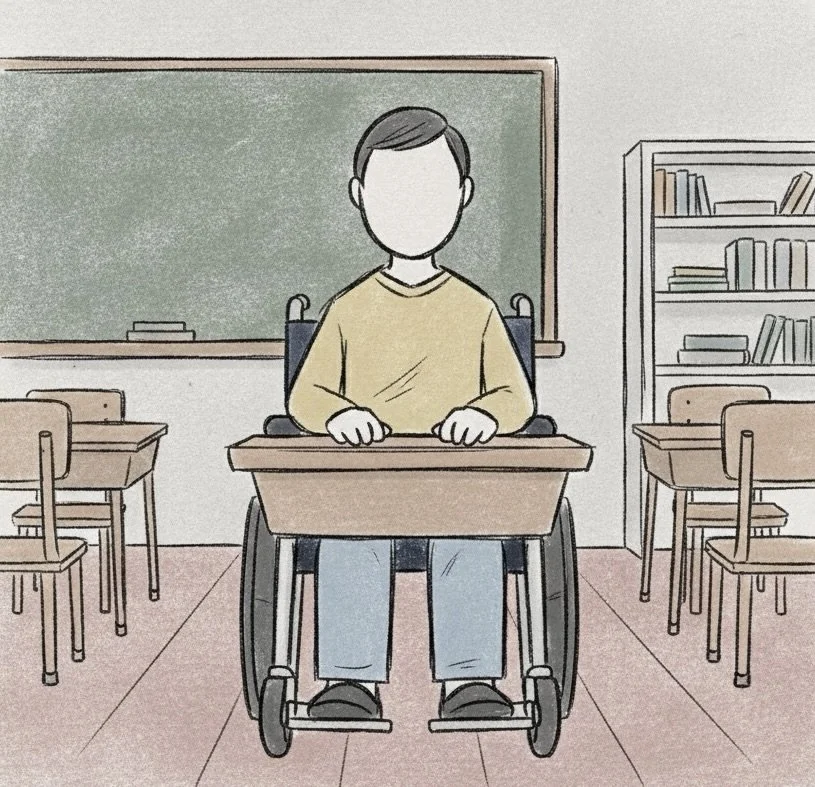
Article by: Lucia Galvan / Graphic by: Naya Moukabary
The pursuit of educational equity for students with disabilities is one of education's most complex challenges. While schools have made real progress in accessibility and funding, visible gaps continue to undermine these advances. My experience working with special needs campers at a summer camp taught me that even well-intentioned programs can unintentionally reinforce the divisions they aim to eliminate. This article examines how supportive structures can create opportunities for equity, yet labels and separation often stigmatize the very students we hope to help.
Recent years have seen meaningful improvements in special education funding and accessibility. At the federal level, Congress allocated $15.4 billion for the Individuals with Disabilities Education Act (IDEA) in fiscal year 2024 to support approximately 7.5 million students receiving special education services nationwide (NPR, 2025). Technology has also opened new doors. In January 2024, the U.S. Department of Education issued guidance emphasizing that every IEP team meeting must consider whether students need assistive technology devices and services (Disability Scoop, 2024). These tools range from text-to-speech software to simple solutions like visual schedules and pencil grips.
Despite these advances, serious gaps remain. During the 2024-25 school year, 45 states reported teacher shortages in special education, more than any other field (K-12 Dive, 2025). The academic consequences are severe. According to the 2024 National Assessment of Educational Progress, 72% of fourth graders with disabilities scored below basic in reading, compared to just 34% of their peers without disabilities (K-12 Dive, 2025). Research confirms that high turnover among special educators is especially harmful to students with disabilities and their academic performance.
Resource gaps extend beyond staffing. While federal guidance emphasizes assistive technology, many schools lack the infrastructure, trained staff, or accessible materials needed to support students effectively (Easterseals Arkansas, 2024). These gaps are particularly bad in low-income districts that struggle to supplement inadequate federal and state funding.
Working at a summer camp with special needs campers showed me both the promise and the problems of inclusive programming. The camp brought together children with and without disabilities for shared activities, creating an environment where all campers could participate. In many ways, it worked. I watched real friendships form across ability lines, saw campers with disabilities gain confidence and new skills, and observed how other campers learned empathy through daily interactions.
The camp's success came from its structural support and dedicated staff. Counselors inherently received training on working with diverse abilities. Activities were designed with multiple ways to participate. When challenges came up, and they often did, staff worked together to find creative solutions that honored each camper's needs while keeping the group together. This framework created spaces where campers with disabilities could succeed.
But even in this thoughtfully designed program, subtle forms of separation and stigma persisted. Campers with disabilities often needed one-on-one support during activities, which sometimes isolated them from other kids even while they participated in the same space. I noticed how certain campers internalized messages about what they could and couldn't do, sometimes based more on their labels than on their actual abilities.
The tension between support and separation became clearest during activities requiring significant changes. During swimming, for instance, a camper with mobility challenges needed specialized equipment and close help. While the adaptive equipment let him participate, it also visibly marked him as different. Other campers sometimes treated him with exaggerated gentleness or patronizing kindness. It was well-intentioned but ultimately reinforced a hierarchy of ability.
Studies find that when teacher assistants are assigned to individual students rather than supporting entire classrooms, they may accidentally increase stigma, isolate students with disabilities, and create dependency (National Institutes of Health, n.d.). Even in inclusive settings, the very mechanisms of support can reinforce the distinctions they aim to overcome.
The growing social divide between students labeled "able" and "disabled" is one of education's most troubling challenges. This divide doesn't come primarily from individual differences but from systemic factors like societal attitudes, institutional practices, and the language we use to describe differences.
Stigma remains widespread in schools. Research shows that one in three educators believes learning and attention challenges are sometimes just "laziness," while 43% of parents would not want others to know if their child had a learning disability (Autism Spectrum News, 2025). These attitudes shape classroom culture and expectations. Children pick up on these messages early, with their understanding of disability shaped by the language and assumptions they observe from adults and peers.
The separation of students with disabilities, whether in different classrooms or subtle tracking within inclusive settings, makes this divide worse. Historically, children with disabilities were educated separately from their peers, often in basement rooms or entirely different facilities (UAB Institute for Human Rights, 2023). While obvious segregation has decreased, many students still spend significant time away from general education classrooms. This separation, even when educationally justified, creates social distance and missed opportunities for building relationships.
Programs that directly address stigma show real promise. Special Olympics' Unified Schools program has shown that bringing students with and without intellectual disabilities together for shared activities significantly reduces social isolation and promotes positive attitude changes (Special Olympics, 2022). Similarly, disability education programs that create opportunities for students to discuss disability openly, share experiences, and challenge misconceptions help bridge these divides (Autism Spectrum News, 2025).
True educational equity for students with disabilities requires moving beyond simple measures of funding and access to address the realities that keep inequality alive. Several principles should guide this work.
First, we need to recognize that inclusion is more than just proximity. Putting students with disabilities in general education classrooms is necessary but not enough. True inclusion means providing support without creating dependency or stigma, adapting curriculum while keeping expectations high, and building genuine relationships across ability differences.
Second, we must address attitudes and biases throughout the system. Teacher training needs to go beyond instructional strategies to challenge misconceptions about disability. Without enough special education teachers, appropriate technology, and supportive infrastructure, even well-designed policies fail.
Third, we should carefully examine how support structures may accidentally stigmatize. Well-meaning accommodations sometimes mark students as different in ways that create social barriers. Schools need to think carefully about how to provide necessary support like assistive technology or modified assignments in ways that reduce stigma and increase inclusion.
Finally, we need to challenge the binary of "able" and "disabled." Educational equity requires recognizing that ability exists on a spectrum and that every student has unique strengths and needs.
My experience with special needs campers taught me that good intentions and careful planning create important opportunities for inclusion, but they don't automatically eliminate the social divisions that disability categories create. True equity demands attention to both the policies that distribute resources and the subtle practices that shape daily experiences. Most importantly, it requires understanding that "disability" is not simply a characteristic of individuals but a social construction shaped by environmental barriers, institutional practices, and cultural attitudes. Only by addressing these realities can we move toward genuinely equitable education for every student.
References
Autism Spectrum News. (2025). From exclusion to belonging: Confronting stigma through disability education in schools.
https://autismspectrumnews.org/from-exclusion-to-belonging-confronting-stigma-through-disabi lity-education-in-schools/
Disability Scoop. (2024). Ed Department warns schools not to overlook assistive technology in IEPs.
https://www.disabilityscoop.com/2024/01/25/ed-department-warns-schools-not-to-overlook-assis tive-technology-in-ieps/30714/
Easterseals Arkansas. (2024). The benefits of inclusive education for children with disabilities. https://eastersealsar.com/the-effectiveness-of-inclusive-education-for-children-with-disabilities/
K-12 Dive. (2025). Teacher shortages hinder special education progress: What are the solutions? https://www.k12dive.com/news/teacher-shortages-hinder-special-education-progress-what-are-th e-solutions-IDEA-50-years/806220/
National Institutes of Health. (n.d.). Disabilities inclusive education systems and policies guide for low- and middle-income countries. https://www.ncbi.nlm.nih.gov/books/NBK554622/
NPR. (2025). How the Education Department helps enforce special education laws. https://www.npr.org/2025/04/03/nx-s1-5338953/trump-layoffs-education-department-special-edu cation
Special Olympics. (2022). Social inclusion of students with intellectual disabilities: Global evidence from Special Olympics Unified Schools.
https://resources.specialolympics.org/community-building/youth-and-school/unified-champion-s chools/social-inclusion-of-students-with-intellectual-disabilities-global-evidence-from-special-ol ympics-unified-schools
UAB Institute for Human Rights. (2023). Disabilities and the American education system: From the past to the present.
https://sites.uab.edu/humanrights/2023/02/27/disabilities-and-the-american-education-system-fro m-the-past-to-the-present/