All I Want for Christmas is a Break
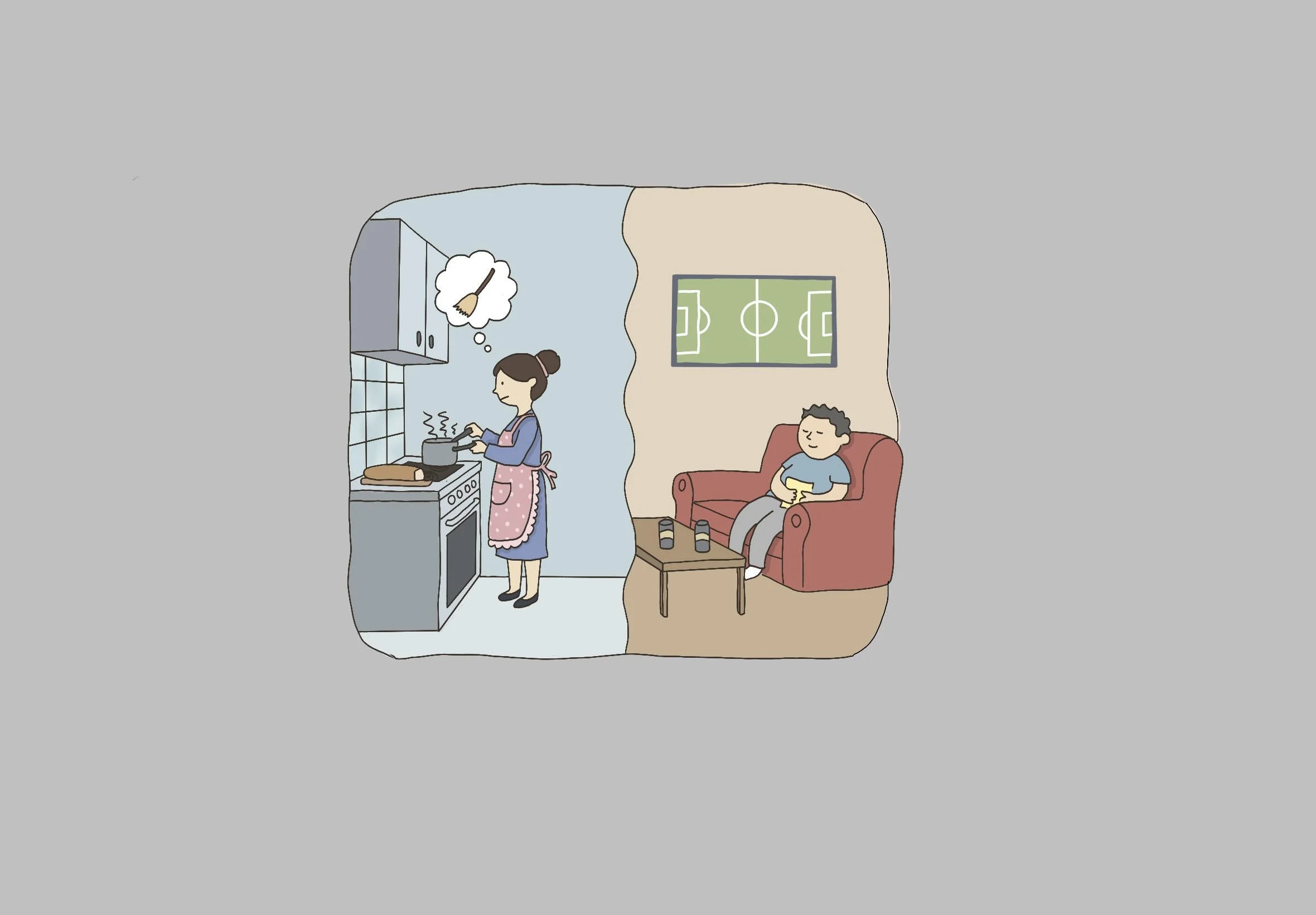
Article by: Amy Boghoussian / Graphic by: Kailyn Mai
Imagine, it’s the week before Christmas and the house is buzzing with activity. The grocery list has grown exponentially, the guest room needs refreshing, gifts need wrapping, holiday cards addressed and stamped, the tree decorated, dinner menus planned, dietary restrictions accounted for, the living room vacuumed. Guests arrive and are greeted, drinks are poured, plates are served, conversation is steered, kids are entertained, leftovers stored. And all the while someone must keep track of the logistics: who’s coming, when they arrive, which dishes they like, where to park, coordinating rides, remembering to say goodbye, to thank people, to send follow-up messages.
Now imagine that the person orchestrating all of this is a woman, a woman who also works a full-time job, drives kids to school, schedules doctor appointments, does laundry, helps with homework, handles bills, and plans everyday meals. For her, the holidays don’t bring a break. They bring a second, unpaid shift, one built on invisible and emotional labor, as well as cultural expectation. This festive time of year magnifies what women are already doing every day, rarely seen, seldom acknowledged, and almost never rewarded.
Holiday celebrations may look magical and effortless on the surface; but behind every cozy gathering lies extensive, unpaid labor, and these seasonal duties do not stand alone. They are layered on top of the regular, daily burdens of household management, caregiving, and emotional upkeep. For working women, this means not just a seasonal surge of tasks, but a doubling down on their ever-present “second shift.” Women spend on average significantly more time than men on unpaid domestic work and childcare across almost all demographic groups, up to twice as many hours per week. Even among full-time employed adults, the imbalance remains: women consistently perform more household labor than their male partners. This means that as a working woman returns home after a day on the job, she often transitions directly into unpaid labor: cooking dinner, cleaning up, tending to children, managing schedules, and yes, planning holiday events, too.
And this unequal burden isn’t new. The expectation that women to manage everything has deep historical roots, and despite decades of progress, that core expectation remains. Research shows that even when women earn as much or more than their partners, they often still take on a larger share of household tasks and emotional maintenance than men. In other words: economic independence has not translated into equitable division of unpaid domestic labor. Thus, holiday labor is not a relic of the ’50s, it is a modern manifestation of a long-standing, culturally ingrained inequality.
The consequences of this unequal burden are profound. The combination of paid work, daily unpaid labor, and the additional demands of holiday planning can lead to burnout, exhaustion, and heightened stress. The invisible nature of this labor makes it easy to ignore, until the fatigue, resentment, or mental health toll becomes unavoidable. And this problem is heightened when it comes to those already facing economic precarity, limited time off, caring responsibilities, or structural disadvantages.
The repeated cycles of unpaid labor, especially emotional labor that is rarely acknowledged, can erode wellbeing, increase feelings of invisibility, and contribute to long-term stress and burnout. But these patterns are not immutable. The imbalance can be addressed, both at the interpersonal level and through broader cultural and structural change. By simultaneously recognizing and valuing the effort they put in, and taking the initiative to help share and redistribute tasks equally, the women around you can experience the holiday break they too deserve.
Bibliography
Alaimo, Kara. “Opinion: Women carry this unequal holiday burden year-round.” CNN, 6 Dec. 2022, www.cnn.com/2022/12/06/opinions/holiday-labor-toll-on-women-alaimo.
Ballard, Jamie. “Men Are More Than Twice as Likely as Women to Do None of the Thanksgiving Cooking and Cleaning.” YouGov, 22 Nov. 2021, today.yougov.com/society/articles/39564-men-more-likely-women-do-none-work-thanksgiving.
Frizzell, Nell. “A Timely Reminder: ‘Invisible Labor’ Is Still Work.” Vogue, 19 Dec. 2023, www.vogue.com/article/invisible-labor-is-still-work.
Hartley, Gemma. “Holiday Magic Is Made by Women. And It’s Killing Us.” HuffPost, 30 Nov. 2023, www.huffpost.com/entry/emotional-labor-holidays-goog_l_6566044ee4b028b0f3cdd845.
Kozlowski, Molly. “Women of Color Need a Vacation.” National Partnership for Women & Families, 20 Mar. 2024, nationalpartnership.org/women-of-color-need-a-vacation.
Morgan, Kate. “The Extra Shift”: The Unpaid Emotional Labour Expected of Women at Work. 14 Mar. 2024, www.bbc.com/worklife/article/20240313-invisible-emotional-labour-women-in-workplace.
Rose, Amanda, PhD. “The Hard Labor of Women.” Psychology Today, 21 Nov. 2018, www.psychologytoday.com/us/blog/between-us/201811/why-many-women-dont-feel-thankful-on-thanksgiving.
Wells, Janelle, PhD, and Doreen MacAulay. “Hosting a Holiday Requires Extensive, Unpaid Work—work That Often Goes Unacknowledged.” Psychology Today, 18 Nov. 2024, www.psychologytoday.com/us/blog/our-invisible-work/202411/the-invisible-labor-of-hosting-thanksgiving.